20h
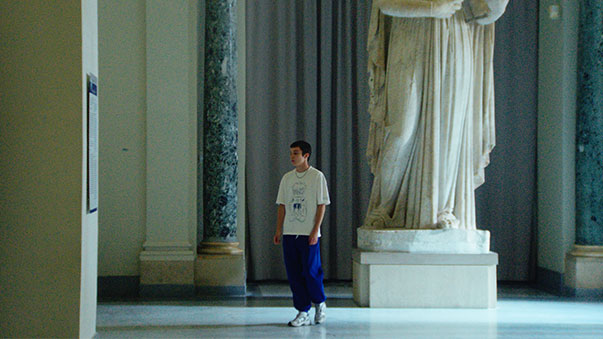
[ANNULE] Avant-première Positif: La Gradiva de Marine Atlan
de Marine Atlan
Film + débat


Documentaire | Etats-Unis | VOA STF | 2018 | 26 min | Fichier Mpeg4
de John Hulsey
Shmuel Gonzales est la preuve vivante de la résilience des communautés immigrées qui ont forgé les États-Unis : ses aïeux Mexicains et Juifs n’ont-ils pas réussi à arriver jusqu’à Los Angeles ? C’est en tout cas ce qu’il se répète pour faire face au traumatisme de se sentir aujourd’hui étranger dans son propre pays – du fait des propos et projets de Donald Trump, mais aussi des transformations de son quartier. Boyle Heights fut jadis le refuge des nouveaux arrivants ; des grues travaillent aujourd’hui à l’aseptiser. Suivant le photographe et historien dans un cimetière ou sur un chantier, John Hulsey semble dérouler les bandelettes d’une ville-momie. Dans les reflets de bâtiments historiques sur les vitrines d’aujourd’hui, il cherche à déceler les traces du cours du temps, passé et à venir, tandis que des images d’archives viennent attester la présence ici-même d’êtres d’une autre époque. Mais comme pour échapper à une vision trop monolithique de l’histoire, le cinéaste présente ces photographies de biais. Elles sont partielles, manipulées, projetées sur des surfaces qui les remodèlent et en matérialisent les strates. En interrogeant une femme qui a grandi en Californie après-guerre, qui raconte qu’il lui était naturel à l’époque de se débarrasser d’un « nez juif » de mauvais aloi, le cinéaste met en avant la farouche volonté d’assimilation de communautés qui parviennent à s’acclimater à un environnement hostile, puis, comme par une tragique ironie de l’histoire, se trouvent poussées hors de ce qui avait fini par devenir un chaleureux refuge.
– Olivia Cooper-Hadjian
Shmuel Gonzales is the living proof of the resilience of the immigrant communities that forged the United States: didn’t his Mexican and Jewish ancestors make it to Los Angeles? In any case, this is what he repeats to himself in order to cope with the trauma of now feeling a foreigner in his own country – due to the remarks and plans of Donald Trump, but also to the transformations in his neighbourhood. Boyle Heights was formerly a refuge for new arrivals; today, cranes are busily sanitising it. Following the photographer-historian into a cemetery or a worksite, John Hulsey seems to be unrolling the bandages of a mummified city. In the reflections of historic buildings in today’s shop windows, he tries to uncover traces of passing time, both past and future, while archive images attest to the presence of humans from another age on the very same spot. But as if to avoid an over-monolithic view of history, the filmmaker presents these photographs obliquely. They are incomplete, manipulated, projected onto surfaces that reshape them and make visible their layers of time. Through his interview of a woman who grew up in post-war California and who explains that, at the time, it was natural to get rid of an unseemly “Jewish nose”, the filmmaker highlights the fierce determination of communities that manage to adapt to a hostile environment and then, through an ironic twist of history, find themselves pushed out of what had become welcoming refuge.
– Olivia Cooper-Hadjian
Documentaire | Chili, France | vostf | 2018 | 72 min | Cinéma Numérique 2K
de René Ballesteros
Who commands the dreams within the castle walls? The said castle is a teenagers’ prison deep in the countryside of southern Chile. The nightmares cause the detainees to scream so loudly that the wardens are troubled. The dreams are inhabited by black horses, sometimes play out in the cells, where the sleepers believe themselves to be awake, and often bring back the deceased – grandparents or victims of the crimes for which these dreamers have been sentenced. Deep in their cells, the young prisoners recollect these dreams for the camera in an uneasy voice that reveals their fear of the next dream. Yet, they still occasionally ask the wardens to tell them scary stories. Los sueños del castillo is clearly aware that these dreams reflect the dreamers’ situation and, on this count, the task of collecting them evokes Sophie Bruneau’s exploration of workers’ dreams in Rêver sous le capitalisme – itself inspired by the seminal The Third Reich of Dreams by Charlotte Beradt. But the confinement, the feeling of guilt and the faraway families may not be the only things that haunt the nights at the castle. Images of the surrounding countryside increasingly slip in between the accounts, and gently weave onto this web of dreams a magical essence that demands to be taken seriously. For a stone’s throw from the prison, lie the remains of an ancient Mapuche cemetery…
–Jérôme Momcilovic
Dans le cadre de